 24°C |
Monday October 12, 2026
24°C |
Monday October 12, 2026 
2 September 2025
Four proposed State Significant Developments in Lavender Bay have prompted opposition from local residents, who argue that the projects would overshadow heritage housing stock, alter the suburb’s character and place pressure on community infrastructure.
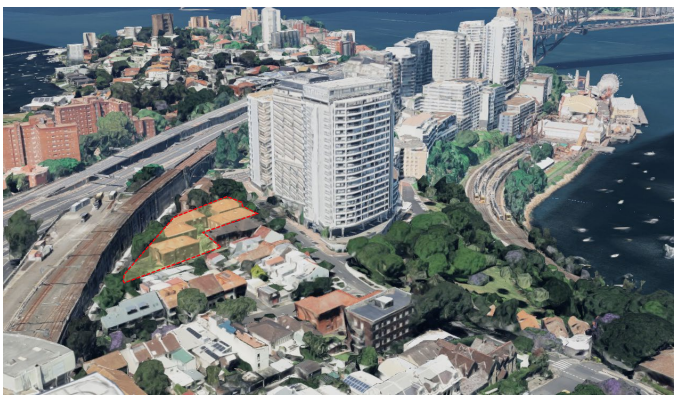
Community group Residents Opposing Lavender Bay Overdevelopment said that the demolition of existing buildings on two of the proposed sites would affect vulnerable tenants. The planned Mackenzie Street project involves replacing the 31-unit St Francis Xavier Terrace Retirement Village, while a development earmarked for the corner of Lavender and Middlemiss Streets affects 50 units, including two social housing blocks. The developer stated in its Scoping Report that no agreement had yet been reached with Homes NSW on the future of those properties.
The Lavender and Middlemiss Street site is adjacent to late-19th-century terraces and includes a 20-storey tower of 70m. Other proposals cover two buildings in North Sydney’s Blue Street, with the existing 14-storey Zurich and 12-storey Fujitsu offices to be replaced with 29-storey and 30-storey towers respectively. Residents argue that the combined effect of these towers, together with the Mackenzie Street plan, would reduce natural light and privacy for nearby dwellings.
“It is important to note that ROLBO is not opposed to development,” said resident Ian Curdie. “We just ask that it is appropriate for, and sympathetic to, its location. These sites were declared SSDs based on their proximity to railway stations – in other parts of Sydney, the Low and Mid-Rise Housing Policy would dictate a 24m maximum limit.”
Curdie added that the group was concerned about the impact of four large projects proceeding simultaneously. “The cumulative effect of four simultaneous, large-scale construction sites, then the subsequent population influx, will overwhelm our suburb’s already inadequate infrastructure,” he said.
Under the NSW planning system, projects can be declared State Significant Developments when they meet certain thresholds or are located in defined areas, such as within proximity to rail stations. SSD designation shifts primary assessment responsibility to the Department of Planning, Housing and Infrastructure, with final determination made by either the independent Planning Panel or the Planning Minister.
Standard local planning controls, such as height or floor-space limits contained in council Local Environmental Plans, are not binding on SSD proposals, although they can be considered in the assessment. This mechanism has been used to facilitate higher-density housing and commercial projects near transport hubs.
By contrast, the NSW government’s Low and Mid-Rise Housing Policy, which applies outside the SSD framework, generally caps building heights at 24m in designated areas. Residents have argued that the Lavender Bay towers exceed what would otherwise be permitted under that policy and set a precedent for similar outcomes elsewhere.
According to local resident Clare Loewenthal, North Sydney mayor Zoe Baker took time out to visit the area on Friday and discuss concerns with affected parties. Lowenthal says there are also plans for a public meeting to discuss the issue in the next few weeks, and urged those interested in attending to contact rolbo2060@gmail.com.
“The proposals effectively double the size of the existing buildings in Blue St and at Middlemiss St, exceed the previous permissible height by 483%. That is huge when you consider these towers are side by side with little terrace houses,” Loewenthal said.