 14°C |
Saturday October 17, 2026
14°C |
Saturday October 17, 2026 
29 June 2026
North Sydney Council has faced a sharp public backlash over its plans to charge more users of public parks, restrict commercial kayak operators and press ahead with Hume Street Park expansion without a secured relocation plan for Kelly’s Place Children’s Centre.
The criticisms came at a packed public forum tonight as councillors consider a set of reports dealing with commercial and group use of open space, the 2026-27 fees and charges schedule, and the long-running effort to find a new home for Kelly’s Place, which occupies land needed for the second stage of Hume Street Park.
Council officers have recommended a revised fees regime for commercial and group use of parks, with implementation now proposed from 1 October 2026 to give businesses more time to adapt. The changes follow a post-exhibition process that drew 81 submissions, including 56 survey responses and 25 written submissions.
The council report said community feedback showed support for a user-pays approach for commercial activity and strong support for keeping casual community use free of charge. But it also acknowledged concerns about the impact on small business, affordability and the perception that the charges may be more about revenue raising than managing public land.
Those concerns were reinforced in the public forum.
McMahons Point resident Ben Keeble said he supported the principle that businesses using public land should contribute, but argued the proposed per-session fee for fitness operators could become open-ended and unpredictable.
Using the example of a local trainer running seven bootcamps a week, he said the charge could reach more than $9,000 a year if the operator had to book at the higher attendance band each time. He called for an annual cap of $2,500, saying that figure reflected council’s own “reasonableness test” for a trainer running five sessions a week over 48 weeks.
“The cap changes one thing. It stops the meter once a fair annual contribution is made,” he said.
Picnic operators also rounded on the proposed charges, warning that the revised schedule still singled out their industry despite concessions made after the exhibition. Paige Montgomery, who runs Pop and Picnics and said she was speaking for a coalition of North Sydney picnic and event operators and 703 petition signatories, said operators supported an annual permit but objected to being charged per head with no ceiling.
She said a 20-person commercial bootcamp in a category one park would pay $25, while a 20-person commercial picnic in the same park would pay $300 — “12 times more for a quieter, stiller activity.” Another speaker argued the annual permit already gave council the accountability it wanted, including insurance, registration and “leave no trace” conditions, and said the per-head charge added revenue but “not a single safeguard” beyond those controls. Operators urged council to charge per booking rather than per head, apply fees only above 21 people, guarantee same-day approvals and cap commercial picnic charges at $200, in line with private gatherings.
Others supported the council’s direction. Kirribilli resident Michael Bracka said commercial operators and private schools should not be able to use community parks without contributing to their maintenance. He said rubbish left after events was “frankly appalling” and argued the proposal was “fair, reasonable, just and appropriate.”
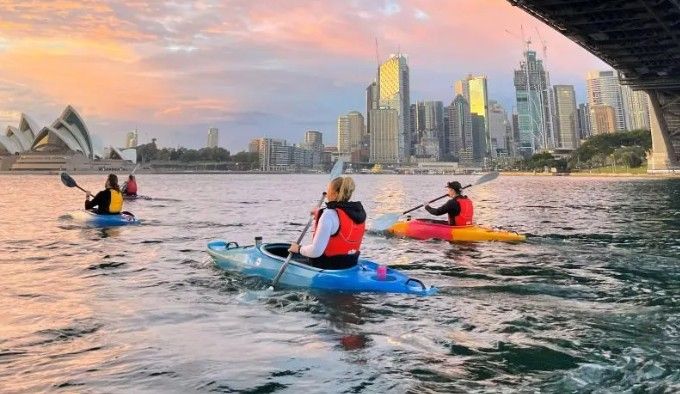
The most contentious operational issue concerned kayak operators. Council’s earlier open space policy proposed that commercial kayak operations at Quibaree Park, Blues Point Reserve and Milson Park be managed through an expression of interest process, with one operator only per site for an initial two-year period.
Sydney Kayak Experience representative Tierna Maguire said her business supported better management of kayak and commercial park activity, but warned the “one company per location” rule could unintentionally displace established operators.
She said the business had run guided harbour tours for five years, with sunrise tours from Milson Park and sunset tours from Lavender Bay. Lavender Bay was chosen for evening tours because it was more sheltered, while Milson Park was more exposed to afternoon and evening winds.
McGuire said the company had invested thousands of dollars marketing the sunset tour, built tourism partnerships and already had bookings extending into 2027. She asked council to consider time-of-day use, rather than granting exclusive control of a location to one operator regardless of whether it used the site for sunrise or sunset tours.
“We are not seeking to be the only operator for sunset,” she said. “We would just like council to consider operators and recognise different times of the day that the location is used.”
The wider dispute over park use was overshadowed by anger over Kelly’s Place, with parents, former families and supporters warning that council was moving towards closure without a credible relocation pathway.
The Hume Street Park Council report says planning studies and adopted council strategies have consistently identified the Kelly’s Place site as needed for the full park expansion. It also says that despite extensive investigations over many years, neither council nor Kelly’s Place has identified a viable relocation site.
Council officers have recommended that councillors note the report and authorise the chief executive officer to work with Kelly’s Place on appropriate transition arrangements and support before the centre’s lease expires on 31 December 2026.
Parents and supporters rejected the idea that the centre’s closure should be treated as inevitable.
Several speakers said council should not force the community to choose between more green space and childcare. They argued that a site in Bank Street, North Sydney remained a credible option and that integration of Kelly’s Place into the Hume Street Park design had not been properly tested.
Kelly’s Place director Katie Newton said the centre had served the community for decades and that its grass-roofed design already showed how childcare and open space could coexist. She said more than $200,000 had been invested in upgrades to the building and argued that integrating the centre into the park would preserve 40 childcare places.
Other speakers said the centre supported around 40 families each week and had a long waiting list, making its loss particularly acute in an area facing rising density and increasing demand for services.
The council report argues that further delay is unlikely to improve the prospect of finding a suitable relocation site, given land constraints, population growth and competing infrastructure demands in Crows Nest and St Leonards.
But that conclusion did little to satisfy speakers, who said the process had failed to deliver on years of assurances that a replacement could be found.
One parent told councillors that if they proceeded without a realistic timeframe for relocation, they were “really committing to closing the centre this year.”