 14°C |
Saturday October 17, 2026
14°C |
Saturday October 17, 2026 
22 September 2026
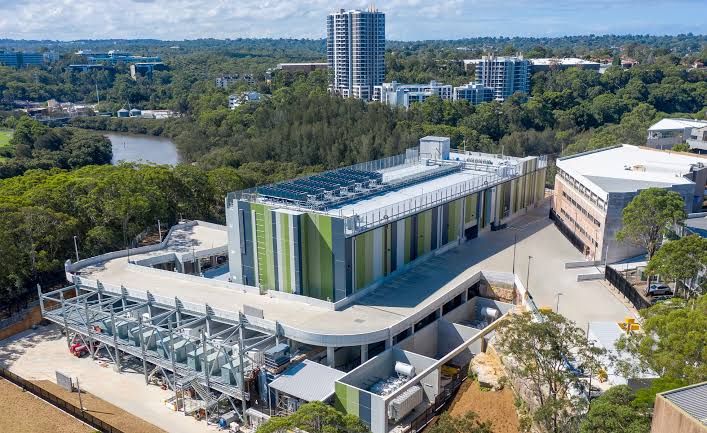
Northern Sydney councils have identified 27 existing or potential data centre sites across the region, including 11 in the Willoughby local government area, as development pressure intensifies around several of Sydney’s principal connectivity hubs.
Willoughby mayor and Northern Sydney Regional Organisation of Councils president Tanya Taylor spoke at a Senate Environment and Communications References Committee hearing in Lane Cove on Tuesday.

Taylor said ten of the 11 identified Willoughby sites were already operational. Across Lane Cove, Willoughby and Ryde, the 27 sites represented around 1,000MW of known build-out power capacity and approximately 232,000 square metres of data centre space.
“This isn’t a theoretical or future issue,” Taylor told the committee. “Our councils are already at the front line of data centre development.”
NSROC represents eight councils across northern Sydney, including North Sydney, Lane Cove, Willoughby, Ryde, Hornsby, Ku-ring-gai, Mosman and Hunters Hill.
Taylor said the organisation wanted data centres to impose no net cost on local communities and small businesses while driving investment in additional renewable energy generation.
It was also seeking stronger requirements covering water and electricity consumption, noise, fire safety, stormwater, tree canopy and light pollution.
NSROC argued data centres should not displace strategically important industrial and employment land or be built within 800 metres of train and metro stations. Taylor said land around those stations should be prioritised for housing and commercial development to maximise the return from public transport investment.
“We’re seeking really a long-term strategic lens for how and where data centres are developed,” she said.
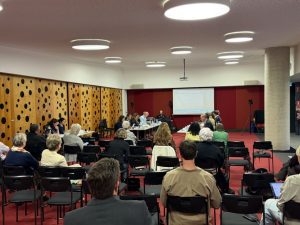
The hearing was held at the Waterview Community Centre before senators Sarah Henderson, Sarah Hanson-Young and David Pocock, with Labor senator Varun Ghosh participating by video link.
Lane Cove has emerged as a major data centre development zone, with Goodman and AirTrunk pursuing new capacity in the area. Neighbouring Artarmon already hosts facilities operated by NEXTDC and other providers.
Lane Cove deputy mayor Rochelle Flood told the committee that data centres at the scale now proposed were “essentially an extractive industry”.
“They’re using enormous amounts of energy, water and land, and our local communities are being left to carry the costs with little to no benefit,” Flood said.
Two major developments have been proposed for the Lane Cove area. Goodman’s Project Mars is a proposed three-storey, 90MW facility operating around the clock with 49 diesel backup generators. Planning documents estimate it could consume more than 510,000 cubic metres of drinking water annually.
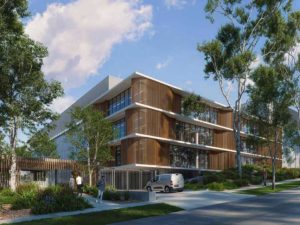
AirTrunk has proposed a separate five-storey, 140MW development with 120 diesel backup generators.
Flood said Lane Cove Council was concerned that cumulative impacts were not being adequately assessed, including the potential effects on air quality, energy and water supplies, employment land and nearby bushland.
She said data centres could eventually occupy almost half of the Lane Cove West Business Park and called for a moratorium until stronger sustainability and planning rules were established.
The committee also heard from local resident Paul Trainor, who questioned whether communities had any meaningful influence over the location of major developments.
“When infrastructure can impose profound and lasting change on a community, yet that community has no real influence over location, we need to ask what social licence actually means for an industry expanding at this scale,” Trainor said.
Goodman told the hearing it expected to decide by the end of the year whether to proceed with its contested Lane Cove proposal after acknowledging that it had not secured a social licence for the project.
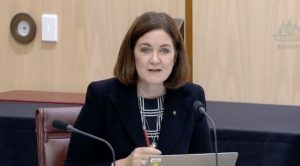
The company came under sustained pressure from Liberal senator Sarah Henderson over the proposed development’s proximity to neighbouring homes.
Henderson urged Goodman to withdraw the application, describing a proposal to build a large data centre about 16 to 20 metres from residences as “grossly irresponsible”.
“I’m seeking confirmation today that you are going to withdraw this proposal and that you are not going to build a data centre 16 metres from the homes where people live,” she said.
Goodman general manager of development Ben McGilp declined to give that commitment, saying the company had not decided how to proceed.
“I expect by the end of the year we’ve made a decision about what happens next with this development,” McGilp said.
He acknowledged that Goodman had more work to do to secure community support.
“I’m not suggesting we’ve reached social licence in that particular example at Lane Cove,” he said. “I think we’ve got work to do.”
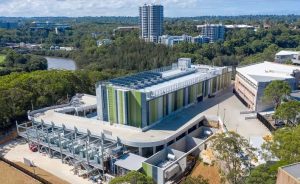
Henderson also questioned AirTrunk vice president of origination and market expansion Tom MacKellar about appropriate separation distances between data centres and homes.
MacKellar said AirTrunk’s existing Lane Cove facility was around 600 metres from the adjoining residential boundary, although one building on Epping Road was approximately 220 metres away as the crow flies.
AirTrunk said its existing 86MW SYD2 Lane Cove campus was approaching capacity. A further 40MW was under construction and expected to be completed within 12 to 18 months.