 20°C |
Tuesday October 13, 2026
20°C |
Tuesday October 13, 2026 
10 August 2026
North Sydney Council has voted to proceed with its controversial Neutral Bay to Mosman cycleway despite intense opposition from residents living along the proposed route and a rowdy council debate that repeatedly forced Mayor Zoë Baker to call the public gallery to order.
Councillors divided along the council’s predictable 6-3 line to endorse the revised concept, rejecting calls to defer the project for new traffic studies, a safety audit and further consultation with affected residents.
The vote followed a 90-minute public forum in which the overwhelming majority of speakers opposed the current design or asked council to reconsider it. Residents of Harrison, Barry, Yeo and surrounding streets raised concerns about parking, emergency vehicle access, traffic diversions, pedestrian safety and the age of the traffic data underpinning the proposal.
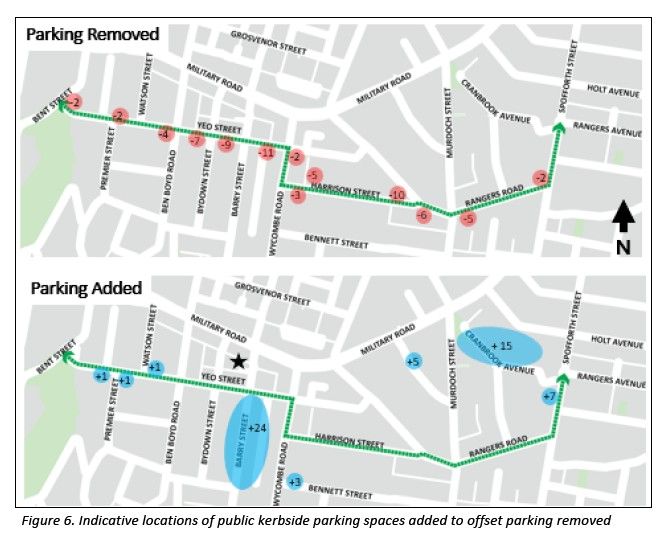
Much of the opposition centred on Harrison Street, where council has substantially changed the design that was placed on exhibition. Harrison will now remain two-way but be reduced to a single traffic lane in sections, while its eastern end will be closed to vehicles at Rangers Road and converted partly to green space.
Residents argued they had never been consulted on that configuration and should be given the opportunity to respond before it was approved.
Christina, a long-term Harrison Street resident, said the closure outside her property “was never in the original proposal”.
“It’s a material change to the proposal that was consulted on,” she said. “So this is a big change and that really needs to go to public consultation.”
She also questioned how emergency vehicles, tradespeople and visitors would access properties once parking was removed and the street narrowed.
Kylie, another resident, told councillors the proposal before them was “not the concept design the community was originally asked to comment on”.
“It is a new design that makes major changes to parking, traffic movements, access, and the way our entire street will operate,” she said.
“The community should be consulted on the proposal that is actually being voted on tonight.”
Kylie also questioned the use of Saturday traffic observations to assess a street where parking pressure was greatest on weekdays and called for a 30km/h quietway to be considered instead.
Sarah Jane, speaking for 60 residents of an apartment block at 21 Harrison Street, said they were informed of the post-exhibition report only six days before the meeting. She called for a further exhibition period, contemporary traffic modelling and consideration of a quietway allowing bicycles, cars and emergency vehicles to continue sharing the street.
Another resident, Matthew made a similar case, saying councillors were being asked to vote on a design “materially different” from the one previously exhibited.
“These are significant changes that were not in the original concept design, have not been properly examined by council, have not been considered by any traffic impact report, and no community feedback has been sought on this new design,” he said.
John, who has lived on Harrison Street for 20 years, said cyclists already shared the street with cars and warned that installing the separated path would create unnecessary disruption. He raised concerns about the loss of parking, mature trees and access for ambulances, fire trucks, removal vans and other large vehicles.
The concerns extended beyond Harrison Street.
Neutral Precinct co-convenor Chris Bosley said the traffic study relied on 2023 information that predated substantial increases in planned housing density around Neutral Bay. The precinct sought a new study covering surrounding streets and undertaken during genuine peak periods.
One resident said making Barry Street one-way would redirect traffic through Bydown and Lindsay streets near Neutral Bay Public School while concentrating displaced parking on Barry Street.
“Councillors, you’re being asked to make this decision without the complete picture,” she said during the forum.
Sarah Kok, chair of the Harrison-Bennett Precinct, asked council not to endorse the concept, calling for publication of submissions, renewed consultation on Harrison Street, updated modelling of cumulative development impacts and assessment of emergency-service response times.
“We actually identified 16 DAs in the pipeline amounting to over 1,500 car spaces. And we asked council to consider the cumulated traffic impacts. Council’s response was to consider the impact of only one of these DAs. And on the basis of this one DA concluded that no update to the traffic modeling would be required,” Kok said.
Cesare Divaroli, an architect representing the board of Cremorne Synagogue, raised concerns about the removal of parking on Yeo Street, including a disabled parking space used by elderly and disabled members of the congregation. He also questioned the effect of narrowing Yeo Street on fire trucks entering and leaving the nearby Neutral Bay fire station.
Council’s own consultation showed particularly strong resistance to changes in Harrison and Barry streets. Some 56% opposed the original proposal to make Harrison one-way and 60% opposed the Barry Street conversion.
Councillor Jessica Keen moved to defer the decision until further community consultation, a traffic impact study and an independent safety audit had been undertaken. Her motion also sought responses to issues raised by residents, publication of consultation submissions and consideration by the traffic committee. However, the mayor ruled this out on unclear procedural grounds.
Instead, an amendment was moved that essentially reinstated the staff recommendation while adding the North Sydney Transport Association and Neutral Bay Synagogue to the organisations involved in detailed design and requiring further consideration of treatments at the Yeo Street and Wycombe Road intersection.
That became the substantive motion and was carried.
Keen told the meeting councillors should respond to what they had just heard from residents.
“Have we not heard what everybody has said tonight?” she said, citing concerns raised over Harrison Street, Barry Street and access to the synagogue.
“Sometimes the actual staff don’t get it right. So that’s why we’re here, because we’re elected to actually stand up for the residents and say, ‘Hey, maybe there is another way’.”
She said the proposed changes were impractical around a precinct containing a school, childcare centres, a hospital and the Neutral Bay fire station.
Councillors supporting a deferral also focused heavily on process. Cr James Spenceley said residents were being asked to accept a “multi-decade, if not permanent solution” without adequate consultation on the revised design.
“This is not a no to a cycleway. It’s a yes to bringing the community with us,” he said, calling for new traffic modelling and further community engagement.
He described reliance on older traffic data while major new development was proposed around the route as “ridiculous” and “embarrassing”.
Cr Efi Carr, also backing deferral, pointed to the age of the traffic assessment, the absence of changes to Harrison Street from the original analysis and the subsequent increase in development planned around Neutral Bay.
Carr noted that council’s age-weighted consultation results showed majority opposition and said the proposed net loss of 11 parking spaces differed from earlier assurances that there would be no net parking loss.
Supporters argued that growing residential density strengthened the case for alternatives to cars and that council had already undertaken extensive consultation.
Cr Angus Hoy said the low and mid-rise housing reforms made additional transport options more important and described cycleways as an efficient use of limited street space.
He acknowledged the concerns of Barry and Harrison Street residents but stressed that councillors were approving a concept rather than a completed design.
“What we are voting on tonight is a concept design subject to further refinement,” Hoy said.
Other supporters pointed to more than a decade of council planning for an east-west cycling connection between Neutral Bay, North Sydney and the Harbour Bridge.
Mayor Baker strongly defended the consultation process, rejecting claims that council was rushing the project.
“This isn’t a rushed process. It is transparent,” Baker said.
“It is not an inevitable ongoing cycle of community consultation until the loudest voices get exactly what they want.”
Baker argued the approaching wave of higher-density development made active transport infrastructure increasingly important, with North Sydney facing a housing target of 5,900 additional dwellings by 2029 and further development through state planning reforms.
The debate became increasingly heated as residents in the gallery interjected during speeches supporting the project. Baker repeatedly called the gallery to order and at one point told attendees they had listened respectfully to councillors they agreed with but were refusing the same opportunity to those supporting the cycleway.
The amendment backing the project was eventually carried, after which it became the motion and was carried again. Votes for it came from Baker and councillors Beregi, Antonini, Holding, Santer and Hoy.
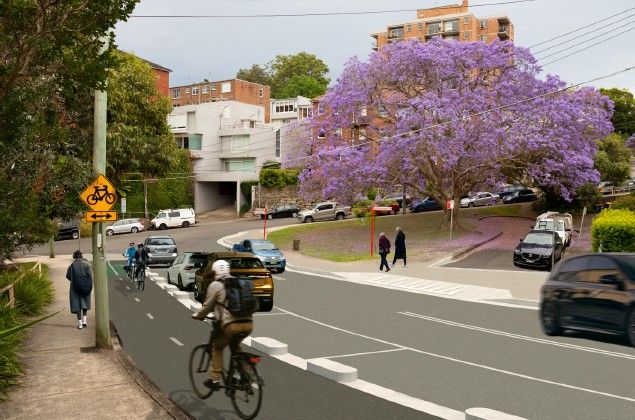
The decision allows council to continue detailed design of the 1.5km route, including the closure of Harrison Street at Rangers Road, the separated cycleway through Yeo, Wycombe, Harrison and Rangers roads, parking changes and peak-hour turning restrictions.
Baker said the route had emerged from successive community consultations.
The final design will still require technical assessment through the traffic committee before returning to council. Council staff told the meeting the traffic committee deals with a design after council has resolved to proceed, rather than acting as a workshop for the concept itself.
Construction is estimated to cost about $6.8 million and remains dependent on external funding.