 19°C |
Tuesday September 29, 2026
19°C |
Tuesday September 29, 2026 

20 June 2025
By James Mullan
Let’s start at the end with a standing ovation. The North Sydney Sun has covered plenty of Ensemble Theatre productions and has never seen a crowd so quick to applaud as they did for The Half-Life of Marie Curie.
Actors Rebecca Massey (Hertha Ayrton) and Gabriel Swathorn (Marie Curie) offered a performance for the ages with a chemistry so palpable you felt as if you had been brought onto stage and into a deep friendship.
One could have watched Swathorn and Massey bounce off each other for hours and never got bored or dropped focus.
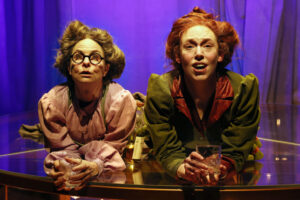
In 1911, Marie Curie won the Nobel Prize in Chemistry for discovering radium and polonium. But just a year later, her incredible scientific work was completely overshadowed by harsh public rumors surrounding an affair with a married man.
Her friend Hertha Ayrton felt that the famous scientist had been unfairly judged. In the eye of the storm of media criticism and public outrage, she was the only person who had come to comfort Curie.
Immediately the audience was drawn to Massey, embodying warmth and fierceness, which continued to radiate throughout the production. Not only did she evoke familiarity as a friend but almost as a strong motherly figure in the way she was comforting to Curie.
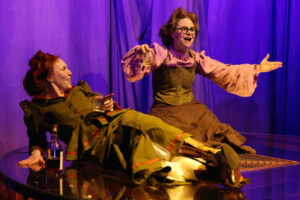
On the other hand, Curie was out of sorts due to the public scrutiny, judgment, and the potential loss of her life’s work. An otherwise strong person was sad, angry, and frustrated.
Gabrielle Swathorn masterfully embodied the character who was not only suffering from mental anguish but physically, after years of radiation exposure, it had caught up to her. Swathorn’s control of her body was astonishing, balancing a character who was strong-willed yet medically and spiritually diminished.
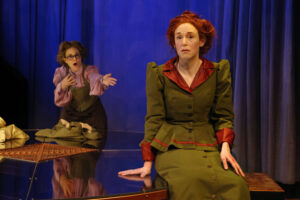
Ayrton had come to save the day, eventually convincing a stubborn Curie to leave the pressure of France to come join her in rural England.
In England, the chemistry and the dinners of the friendship between these two highly intelligent women became extremely evident. The set itself was quite simple, however, the lighting design was exquisite. A round glass platform sat center stage, with old bronze light bulbs underneath, paying homage to one of Ayrton’s inventions.
The stripped-down minimalist set provided a perfect playground for the actors to build energy and to invite the audience into the friendship between the two characters. It might have been a relatively blank canvas, however, it was full of colour thanks to the incredible performance from Swathorn and Massey.
This was a testament to the work of set and costume Designer James Brown who not only created the setting but designed costumes that were eerily accurate to the era, all the way down to the undergarments.
This helped the actors embody the characters even more with the almost repressive nature of early 1910s fashion symbolising the repression and societal limitation that both these female geniuses faced.
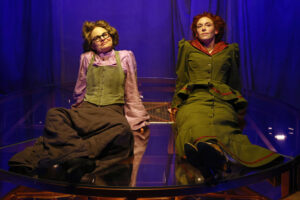
The audience was given an intimate insight into the two characters’ friendship through the dark, frustrating, and angsty moments to the moments of innocent joy that they experienced, again a testament to the range of Swathorn and Massey.
Commendation must also be given to director Liesel Badorrek who was able to pace and stage the production in a way that brought the best out of the two actors. Badorrek is already familiar with the Ensemble stage, again creating a rich and evocative atmosphere in a small performance space.
Playwright Lauren Gunderson had tapped into an interesting period in Curie’s life. Instead of choosing to highlight the high points of Curie’s fascinating life, she zoomed in to the lowest point. Humanity was not lost through Gunderson’s writing, drawing a huge degree of sympathy from the audience.
This ensemble production was a must-watch. At the end of the play, not only did you feel as if you wanted to get off your feet and give these two actors a standing ovation, but you wanted to go over and hug them. Such was the strength of their performance, bringing these two complex and historically significant characters to life in such a multi-dimensional way.
The Half-Life of Marie Curie ran until the 12th of July. Visit ensemble.com.au for showtimes and tickets.